

Director of Sustainability Marketing
4 min read

It’s only three words. But the search term “Offset Flight Emissions” can carry a lot of baggage for many people. Over the next few paragraphs we will unpack the assumptions, and provide some clear, scientifically grounded and easily actionable guidance on how best to proceed.
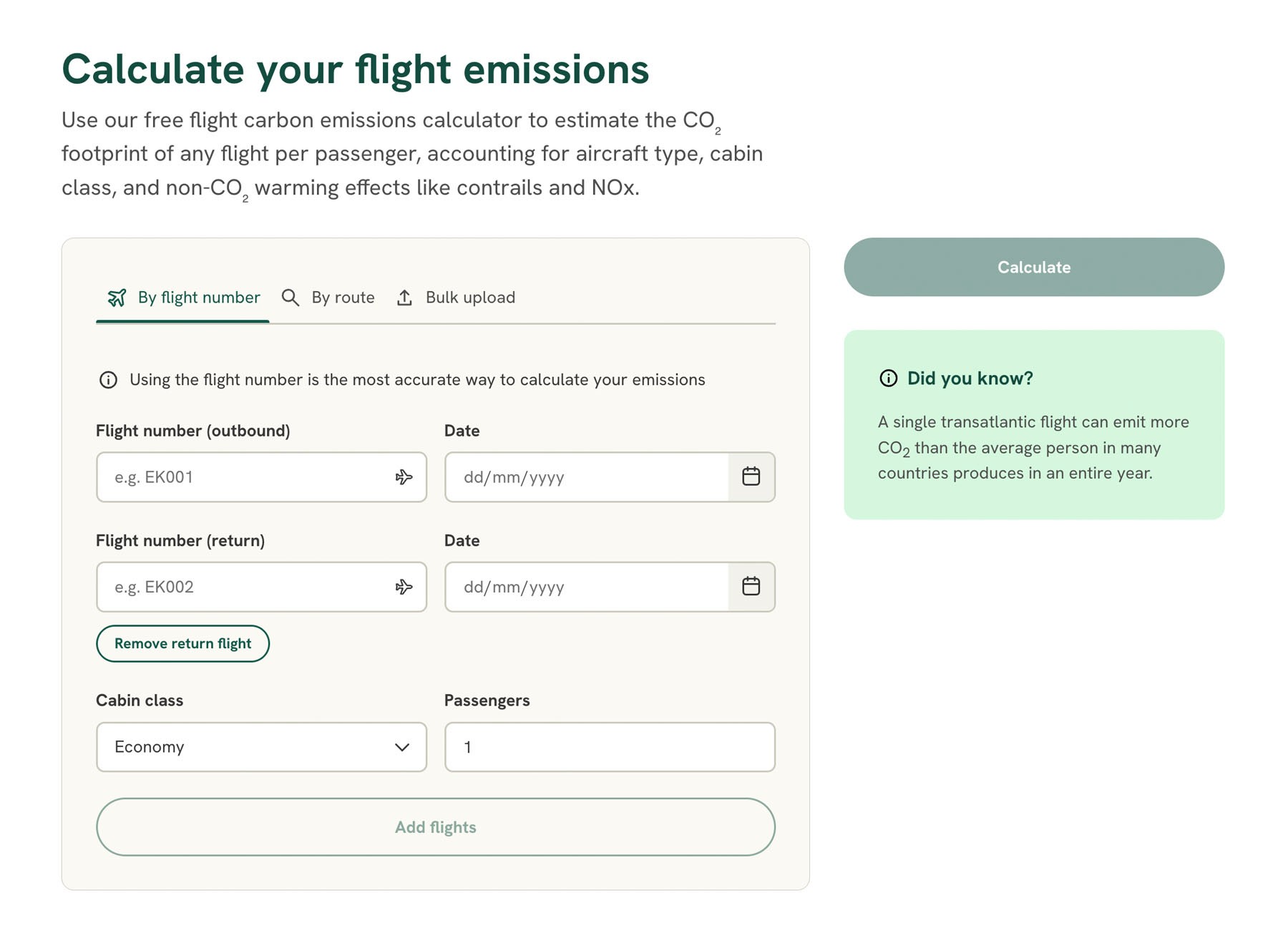
Calculate your flight emissions
Enter your flight number in our flight emissions calculator to measure the exact carbon impact of your journey.
What does it mean to offset flight emissions?
Offsetting flight emissions means funding verified climate projects that reduce or remove greenhouse gases, alongside reducing your own emissions. It does not cancel out emissions, but contributes to broader climate mitigation.
Why aviation emissions matter
First off, the (relatively) uncontroversial bit. Flying is one of the most carbon intensive activities any one of us might do in any given year. A return economy flight from London to New York lasts just a few hours each way, but it generates a similar amount of greenhouse gas emissions to powering the average house in the UK for over 200 days, according to our new flight emissions calculator, which we’ve designed to enable a more accurate and user friendly way to measure the emissions from any specific journey a business or individual flyer might take.
For individuals, a flight will represent a large share of their annual emissions. For businesses, travel often sits within Scope 3 or supply chain emissions, making it harder to measure, but no less significant. Customers, employees, and regulators are paying ever closer attention to how emissions are accounted for. Initiatives like the first global aviation offsetting framework known as CORSIA (the Carbon Offsetting and Reduction Scheme for International Aviation) reflect the ever increasing scrutiny of aviation’s contribution to climate change.
It’s therefore very understandable, especially as the impacts of climate change become ever more apparent, that growing numbers of people want to better understand and reduce the impact associated with their flights and other activities.
How best to address flight emissions
Here at Ecologi, we are committed to delivering climate solutions and advice to businesses, organisations and individuals based on the most rigorous, up to date, science. Our approach to this is guided by our core 3Rs framework - Reduce, Restore, Report.
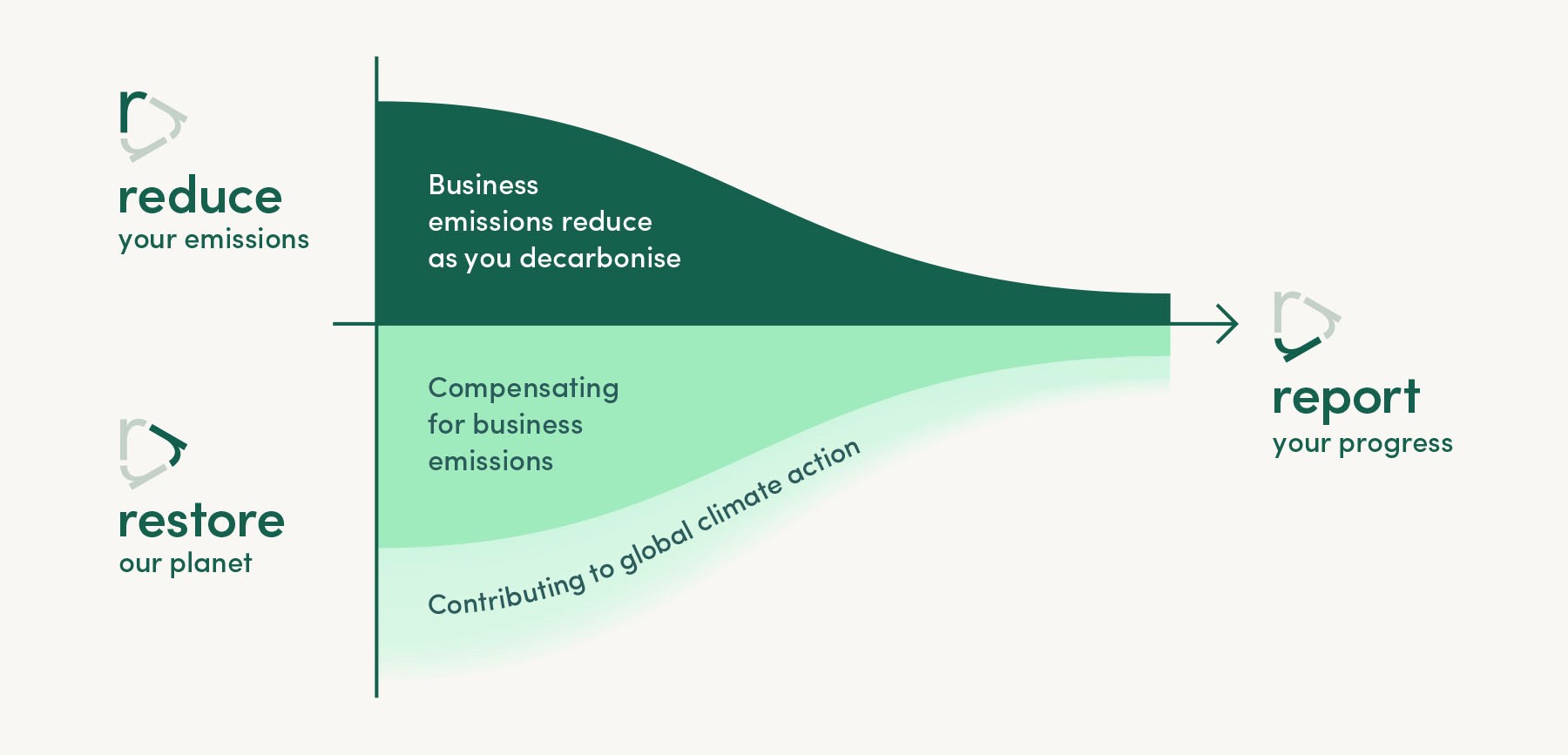
It doesn’t matter whether we are supporting businesses to address the entire climate impact of their portfolio and meet their reporting requirements (for example with our new bulk upload function), or helping out a family who take one return flight a year for their holidays. The approach remains the same.
A hierarchical approach to addressing emissions is widely accepted as the best approach, but it isn’t universally followed, especially when it comes to agreeing what the best way to deal with aviation is. Type a phrase like ‘offset flights’, ‘carbon emissions per flight’ or ‘best carbon footprint calculator’ into a search engine and a huge selection of tools and approaches will indeed be offered. Alongside them there will be harshly critical articles rejecting the premise of offsetting the carbon footprint of flying altogether.
What then is the most effective action an individual or business can take to reduce travel emissions, and why?
1: Reduce
There’s no two ways about it. When it comes to a high emitting activity like flying, the most impactful thing you can do is reduce the distance and frequency you fly as much as possible, and therefore reduce the amount of emissions you are responsible for in the first place. So before planning and booking the next flight, first consider whichever of the following questions are relevant to your planned trip:
Do you need to fly at all?
Can you hold the meeting online?
Can you go somewhere closer that doesn’t require a flight?
Or can you get to where you are going by another, less emitting form of transport?
None of this advice is controversial. Both critics and proponents of offsetting will recommend similar questions. Because the simple truth is that offsetting is not enough. We need to reduce emissions first.
Where the real disagreements apply is what you do next.
2: Restore
There was a time (and unfortunately there are still some unscrupulous actors out there), when organisations would present offsetting as a get out of jail free card. They’d offer the chance to neutralise the emissions of your flight, offer ‘Net Zero’ business travel, or even tell you you could now ‘fly green’. This gave a completely erroneous impression that buying carbon credits erased the flight’s emissions. Flying may seem to defy gravity, but unfortunately, science still applies. It takes a lot of energy to get a plane in the air and keep it there, and once those emissions are created, they remain in the atmosphere.
This sort of ‘greenwash’ language has reduced in recent years, and increasingly in Europe is being regulated. However, for many critics of offsetting this mislabelling made doing so beyond the pale, as it was felt that far from reducing flying, it might actually increase it, because people would feel buying carbon credits gave them a license to fly as much as they like, and then pay a small fee.
Here at Ecologi we mostly avoid the use of the word ‘offset’ to describe what we do, only using the term occasionally since it is familiar to our users, and always being clear to explain that funding carbon projects through our platform does not directly negate the emissions you have already caused. Our aim is not to give the impression that you can “cancel out” your emissions, but rather that you can contribute to meaningful climate mitigation and restoration, alongside reduction.
For a full comparison of the leading providers, see our guide to the best carbon offset companies in the UK.

We believe (indeed it's the reason we exist) in the vital importance of shifting funding towards meaningful climate mitigation and restoration projects. Our position is as follows: having reduced the amount of emissions any individual or organisation causes as much as is possible at any given time, the severity of the climate crisis means that to ensure credible and effective climate action we also need to work urgently to restore habitats, sequester emissions and support the development of cleaner ways of meeting our future energy needs. And for anyone who wants to offset flight emissions correctly, we want to give them the information they need to be able to do so in the most scientifically verifiable, transparent and socially just ways possible.
Which brings us to the third pillar in our approach.
3: Report
The other big controversy around carbon offsetting is how to know whether the carbon credits actually work or not. There have been numerous exposés in recent years of failed projects that did not deliver the emissions reductions they promised. Ecologi was launched with the commitment to ensure the verifiable funding of the very best carbon projects around the world -such as the Matavén rainforest protection in Colombia, Landfill gas capture in Turkey, or Blue carbon restoration in Pakistan - and to make this available to businesses, organisations and individuals, so that anyone can be sure that whatever amount of money they spend on supporting our projects, they have the highest levels of confidence that they will deliver.
We pride ourselves on these commitments. Ecologi supports projects that are assessed through a robust Carbon Project Assessment Framework, which measures every project we might support across three pillars:
Climate impact - Does the project deliver measurable carbon reductions or removals?
Nature and biodiversity - Does it support biodiversity, ecosystems or land restoration?
People and communities - Does it respect communities and human rights?
Projects must meet strict thresholds across all three areas, ensuring they deliver meaningful, verified outcomes. This approach also aligns us with the Oxford Principles for net zero-aligned carbon offsetting, helping ensure that our restoration efforts contribute to long-term climate goals.
How to offset flight emissions correctly
We’ve built our new flight carbon calculator to support these aims. The usefulness of a calculator depends on the accuracy of its measurement, which depends on how it is built. Many of the products on the market rely on estimations of distance travelled, aircraft type, perhaps passenger load and maybe additional warming effects at altitude (called ‘radiative forcing’). They often rely on simplified assumptions or outdated data, which can lead to inconsistent or underestimated results.
A more reliable flight emissions calculator needs to reflect the complexity of aviation. Our tool enables you to input a specific flight number, meaning emissions are tailored to the exact journey taken - rather than relying on generic route estimates. It calculates inbound and outbound flights separately, uses the latest DEFRA radiative forcing factors and is powered by the Travel Impact Model (TIM). The TIM is designed by Google, and thanks to its partnership with the Travalyst coalition, is the same methodology used to compare flight emissions across most of the major flight booking platforms. This means our tools allows for more precise estimates than many standard calculators, and aligns with the most widely used ways anyone is likely to book their flight.
Not only are the methodologies we use are the most precise and complete available, we’ve also ensured that the user experience is as simple and smooth as possible, because we know that most people find the concept of emissions measurement extremely difficult. Our research shows that 24% of businesses cite complexity in measuring emissions as a key barrier. So our tool is extremely accurate, and as one user described it, the calculator is “incredibly easy and simple to use.”
Simple, but also designed to increase understanding through use, rather than reduce a complex situation to an insufficient response. It doesn’t just give you a single figure for your emissions and a financial sum to pay. Our aim is to engage our users in getting a deeper, more holistic understanding of their carbon emissions, and to develop this awareness away from a quick fix offset solution towards a long term, fuller engagement in reducing emissions in all aspects of operations and life.
From measurement to meaningful action
In the end, our approach to calculating aviation emissions is as follows.
Using a flight emissions calculator is the starting point.
The value of the information it provides depends on how that information is used.
For individuals, that might mean adjusting travel habits over time and supporting high-quality climate projects where needed.
For businesses, it often means moving beyond one-off actions toward a more structured and comprehensive approach, using tools like Ecologi's Carbon Accounting tool named Ecologi Zero to measure and reduce emissions across operations.
Either way, our aim remains the same - to encourage a broader shift from thinking about offsetting as a quick fix, to approaching climate action as an ongoing and holistic process.
Schedule a call with our team to explore how we can support your business wherever you are on your climate journey.